
A gap appears: someone flags it, or you spot it yourself.How much does it matter for the mission What if you’re closer to closing it than you think?
Not every gap is what it appears to be. Some exist because of how the problem was framed: the missing capability is real, but the need it points to isn’t. Reframing the need can dissolve the gap entirely, or redirect attention toward a different capability.
Some gaps disappear when the problem changes. Others are real but mistimed. Too early: building capability before the work demands it wastes focus and creates maintenance without return. Too late: the gap has already constrained decisions downstream, and closing it now costs more than it would have. Deferral works, but only if you know which side you’re closer to. And elimination is underused when absence feels like failure rather than design.
Every capability decision has a cost. Building costs focus, partnering costs coordination, outsourcing costs oversight, automating costs maintenance, and financing costs obligation. Elimination trades all of it for a bet that the gap doesn’t matter. What’s worth it?
What are you trying to do?
The answer reshapes every question that follows. If the intent is to learn enough to evaluate vendors, building at literacy depth makes sense even for a non-core capability. If the intent is to ship this quarter, outsourcing a core capability might be the right temporary move. How core a capability is depends on the timeframe: what looks like support when optimizing for this year may be core when positioning for next year.
Without a stated intent, decisions default to permanent architecture: build what’s core, outsource what isn’t. But many capability decisions are transitional. You build something to learn it, then hand it off. You outsource something to move fast, then bring it in-house once you understand it. The intent determines whether the structure to build capability is a destination or a bridge.
Where to focus
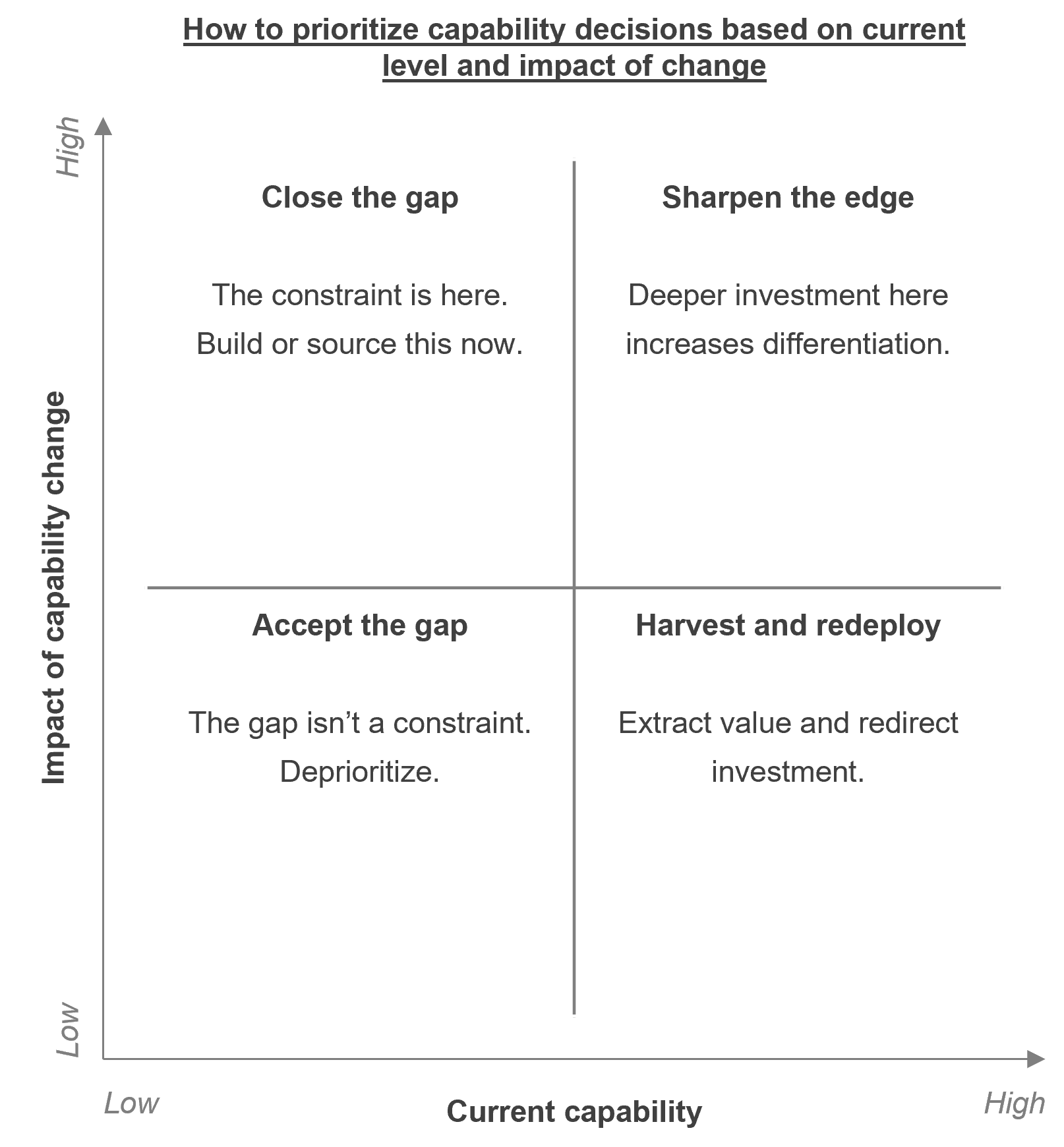
Not every capability deserves the same investment. Some decisions are straightforward. Others carry assumptions that look obvious until tested. Weak in something important: close the gap, but is it a gap you can build internally or requires external sourcing? Strong in something unimportant: harvest and redeploy, but is it really unimportant, and is the assessment wrong about what matters? Strong in something important: is further investment still compounding, or has it plateaued? Weak in something that appears unimportant: is the impact invisible because the capability has never been present, and there’s no baseline to feel what’s missing?
For capabilities worth investing in, the next question is how much. Mastery (years, two or three things at most), proficiency (months, reliably good), functional (weeks, good enough), or literacy (days, enough to evaluate and direct). Outcomes are defined by where mastery is pursued.
No placement is permanent: what sits in “accept the gap” during one phase can become a priority when the work shifts.
Approaches to investing in capabilities
A capability worth investing in can be placed on two axes:
- How core? If this capability disappeared, would the outcome be fundamentally different, or just harder to produce? Without its chef, a restaurant becomes a different place. Without its bookkeeper, it’s the same place run worse.
- How externally available? How easily can this capability be sourced from someone or something else?
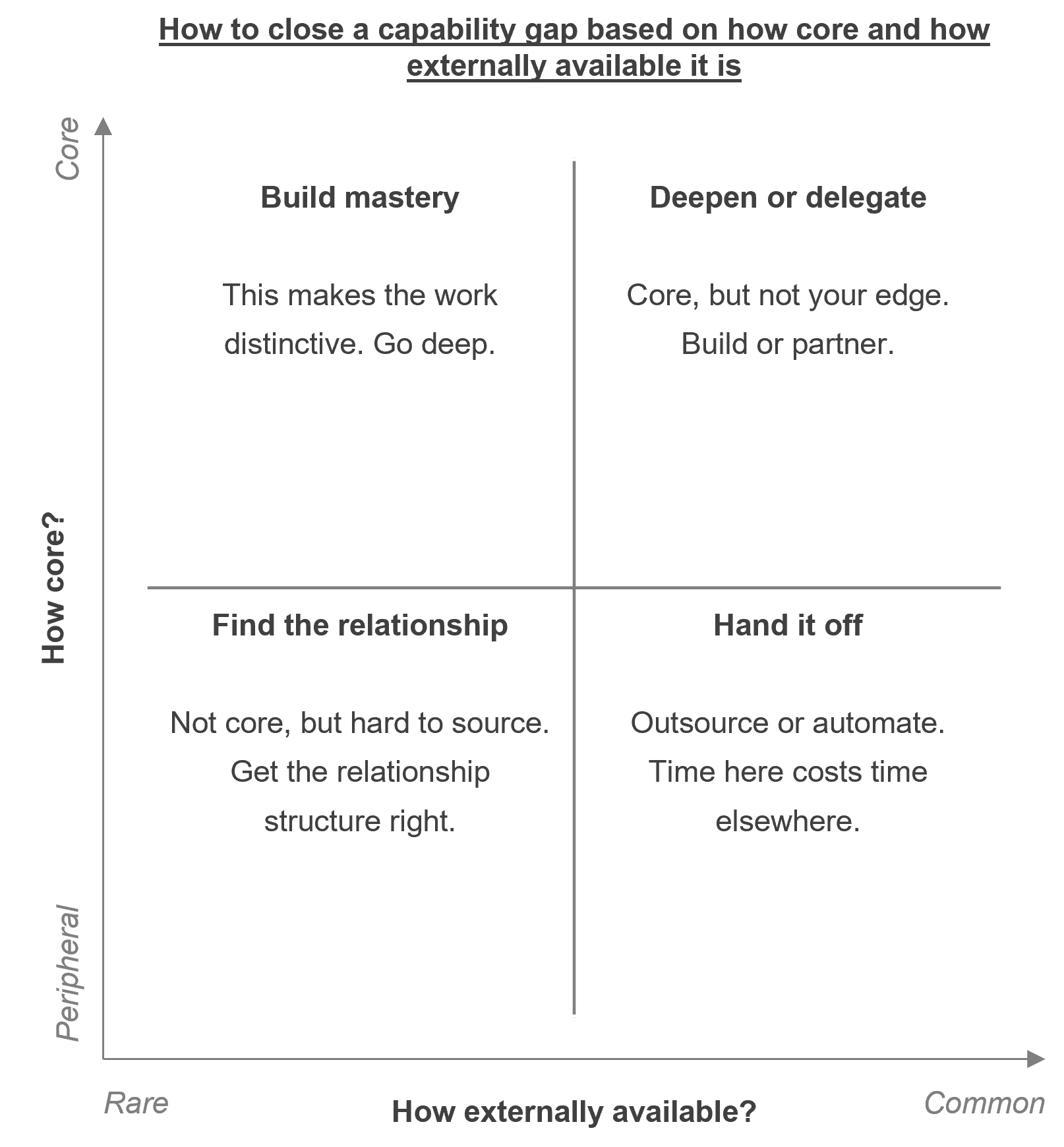
Build is for capabilities that are both core and hard to source elsewhere. An error here is calling something core because it’s always been done internally regardless of how much it differentiates. Outsource and automate are for capabilities that are neither, though both require enough literacy to evaluate what comes back.
Availability is easy to misjudge in both directions. One failed outsourcing attempt doesn’t mean the capability is unavailable. And “agencies exist” doesn’t mean the capability is available at your quality bar, in your context, at your scale.
Partnership applies when the axes pull in different directions: a rare capability that isn’t core needs the right access structure (a hire, a retainer, a formal partner), and a core capability that’s externally available still needs depth. The line between partnership and outsourcing is integration. Outsourcing keeps capability external and bounded: pay for the deliverable, done. Partnership implies ongoing dependency, where the capability becomes part of how the work gets done.
Some capabilities feel core because the handoff is hard, not because they differentiate. That difficulty is usually a property of how the work is organized, not of the capability itself. Restructuring for handoff has a cost; so does avoiding it.
Deciding the structure
Is the need ongoing?
If you need a deliverable, outsource. If you need a relationship, partner.
Hiring fits when the work requires proximity to context and performance is evaluable. A retainer fits when the capability is rare and needed intermittently. A formal partnership fits when genuine complementarity exists: one party’s distribution combined with another’s product, one’s depth combined with another’s access.
When Kitasato and Merck formalized their research partnership in 1973, neither tried to build what the other had. Kitasato screened soil microorganisms. Merck developed and commercialized what Kitasato found. The terms matched the capability split, and the result was ivermectin.
Can it be automated?
Check whether technology handles it well enough at the required depth. For non-core capabilities, full automation may close the gap entirely. For core capabilities, partial automation counts: automate the routine parts, keep the human for judgment. A key consideration is that sometimes doing the work manually first is how you learn what to automate and build judgment.
Is capital the constraint?
Before asking how to finance, ask whether capital is actually what’s missing. “We need funding to build a sales team” might really mean “we need distribution,” which might mean a partner, not a hire.
If it is, the next question is whether the organization can absorb it. Capital that arrives before the capacity to deploy it creates new problems. Debt carries interest whether or not it’s producing returns. Equity creates expectations on a timeline that may not match the organization’s readiness. Grants require attention to funder compliance and priorities. A mismatch can widen the gap capital was raised to close.
Raising and managing capital carries administrative costs at any scale. But those costs increase in steps, not proportionally. Each step requires a higher level of capability: transaction costs to close the deal, ongoing costs to remain compliant, and the internal capacity to manage both. The costs within each range stay roughly flat across wide bands of deal size, but crossing to the next range triggers a steep increase in both cost and required capability. Organizations in the middle face the steepest mismatch: large enough to require the formal process, but not large enough for those costs to become negligible.
Financing also shapes what capability the organization gains. Lenders may bring oversight and operational discipline. Grant funders often bundle capital with technical assistance, networks, or monitoring frameworks. Equity investors assume an ongoing relationship. The question is whether the accompanying involvement builds what’s missing or gets in the way.
If external capital is required, what kind?
Financing structures vary by how much operational involvement accompanies the money. Senior debt sits at one end: capital on defined terms, minimal involvement beyond repayment. Acquisition sits at the other: full integration, the investor absorbs the capability entirely.
A strategic investor wants proximity to a specific capability and may offer distribution or infrastructure in return. A growth equity investor provides capital for scale, with board involvement and timeline expectations. A buyout investor takes control and restructures operations directly. A minority stake preserves independence but limits what the investor can contribute. A majority stake gives the investor control, which helps when their operational capability is the point but constrains when it isn’t.
The test is whether both sides would describe the arrangement the same way. If the organization sees a passive capital source and the investor sees an operational partnership, the working relationship will break down before the legal terms do.
How will you know if the intervention is working?
Each structure that builds capability has its own clock. A hire might need six months to reach full context. A partnership might produce nothing visible in year one and become indispensable in year two. An automation might save time immediately but take quarters to justify the setup cost. Evaluation that ignores the clock biases toward visible activity over actual fit.
The criteria don’t need to be precise. “This automation should cut weekly reporting time in half by the end of the quarter” is enough to evaluate against. Exploratory phases are legitimate, but they need boundaries. What would tell you to commit further, and what would tell you to stop? Without either, “let’s see how it goes” becomes permanent drift.
When a capability decision isn’t working, the first question is whether the structure is wrong or whether the timeline hasn’t played out yet. Restructuring too early wastes the investment. Persisting too long compounds the cost.
The traps recapped
Each option has a characteristic failure. Building: spreading thin. Partnering: choosing the wrong structure. Outsourcing: handing off what makes the work distinctive. Automating: spending more time managing the system than the task would have taken. Eliminating: cutting because it’s hard, not because it’s unnecessary.
Investment carries its own traps. Taking capital from a partner whose capability exchange doesn’t match: capital that bundles operational involvement with an organization whose constraint is funding, or capital that stays hands-off when the organization would benefit from more of the investor’s involvement. Choosing equity when debt would have preserved the control needed to execute. The structure should match the capability split. When it doesn’t, the misalignment compounds with every governance decision.
Placement errors on either matrix are quieter. Labeling a capability core because the transition is costly, not because it creates an edge. Overestimating current capability because you can’t see what good looks like, or overestimating impact because the capability is visible and time-consuming rather than actually constraining.
These errors compound when the two matrices interact. A high-impact gap in a non-core, available capability doesn’t need internal investment. It needs better sourcing: a better vendor, better automation, a clearer specification of “good enough.” A failed outsourcing is data about that attempt, not proof that the capability must be internal.
Alongside gaps, genuine strength can bias judgment too: assuming that because a capability is strong, getting stronger will change outcomes. Competence deepens the pull. The work feels productive because you do it well, which makes it hard to hand off, even when further depth no longer pays. And these assessments drift: what was accurate in one phase could change in the next.
These decisions in history
In the 1880s, Ferdinand de Lesseps arrived in Panama with the architecture that had built the Suez Canal: sea-level dredging through flat desert, funded by persuasive capital-raising. Panama’s problems were different: mountains, tropical hydrology, and diseases. De Lesseps deployed the Suez playbook anyway. The project’s engineering plan followed the Suez model even where the terrain didn’t. Disease was treated reactively, with hospitals for the sick, rather than preventively. A Cuban physician named Carlos Finlay had already published the hypothesis that mosquitoes carried yellow fever, in 1881, before the project began, but it wasn’t acted on.
The financing structure reinforced the blind spot. De Lesseps raised capital through public bond sales to French retail investors, on the strength of his Suez reputation. Institutional investors or backers with engineering experience might have demanded independent engineering and epidemiological review. Instead, the capital came from a source that could evaluate reputation but not the underlying technical plan, and the capability gap was never surfaced until it was too late.
Their hospitals, lacking mosquito netting and surrounded by standing water, likely worsened the outbreaks. Over a decade, an estimated twenty thousand workers died. The engineering and financial capability was real, but the capability that the situation demanded was never built.
In 1973, the Kitasato Institute in Japan and Merck began a research partnership built on complementary gaps. Kitasato had a program to collect and screen soil microorganisms for bioactive compounds, led by microbiologist Satoshi Omura. Merck had the infrastructure to test, develop, and commercialize whatever Kitasato found.
Kitasato would screen samples and send the most promising ones to Merck. Merck would fund the research and handle development. Royalties from any resulting products would flow back to Kitasato.
In 1974, Omura isolated a soil bacterium from a sample collected near a golf course outside Tokyo. Merck’s team, led by William Campbell, identified a potent antiparasitic compound in that sample: avermectin, which became ivermectin. It became the world’s best-selling veterinary drug. Then Campbell hypothesized it could treat river blindness in humans. Merck developed the human formulation and, in 1987, committed to donating it for free, for as long as needed. The WHO handled distribution across Africa and Latin America. Over four billion treatments have been delivered. Omura and Campbell shared the Nobel Prize in 2015.
Kitasato could not have developed the drug. Merck could not have discovered the compound. The WHO could not have done either, but could reach the patients. Each party held a capability that the others lacked. The partnership worked because the terms matched the split, and because no party tried to build what the others already had.
In 1987, Morris Chang founded TSMC in Taiwan on a single capability decision: to focus on fabrication only. Every other semiconductor company designed and manufactured its own chips. Chang saw that only one of those was core. By never designing chips, TSMC could invest entirely in the capability hardest to replicate: manufacturing at the smallest possible scale, at the highest possible yield.
TSMC’s model required capital investment on a scale that only made sense if fabrication was the entire business. Chang secured backing from the Taiwanese government and Philips, both of whom were making their own capability assessment: that paying someone to fabricate was more valuable than maintaining their own fabrication.
That boundary created the foundry model. Companies like Nvidia, Qualcomm, and Apple could exist as design-only firms because TSMC handled the parts they couldn’t build themselves. What TSMC built and what it refused to build is what defined the industry.
The principle
The boundaries between these options have shifted before. Before central power stations arrived in the 1890s, every factory generated its own power with steam engines, coal supplies, and engineers to run them. The grid collapsed “build” into “buy” for most. Some factories justifiably still generate their own electricity because their power requirements are core to what they produce, or because the grid doesn’t service them to their requirements.
A capability portfolio is the product of every investment decision made along the way, consciously or not. Deliberately make the next decision.